
The Four-Phase Model: A Chinese Framework for Understanding Cultural Viscosity and Transformation
Jiakun Wang
Western cultural semiotics often relies on Raymond Williams’ Residual-Dominant-Emergent model. While useful, it struggles with sudden collapse, non-linearity, and the engine of emergence itself. What if we approached cultural change through a different cosmology?
This 15-minute presentation introduces “The Four-Phase Cosmic Breath”—a model integrating Chinese cosmology (四象八卦) and thermodynamics to map cultural transformation as an energetic, cyclical process.
The model proposes four phases, each corresponding to a state in classical Chinese thought:
太阴 (Dissolution): System at maximum entropy – chaotic but pregnant with potential. Old meanings dissolve; seeds of the new lie dormant.
少阳 (Emergence): Negative entropy enters. Local self-organization begins. New cultural forms erupt and expand rapidly.
太阳 (Consolidation): Peak order achieved. Codes crystallize into stable institutions. High clarity, but rigidity looms.
少阴 (Dissipation): Entropy rises again. Structures ossify and fragment. Energy dissipates as the system prepares for renewal.
Within each phase exist two transitional states (八卦) – eight fleeting moments cultures pass through. Cultures rarely rest; they exist primarily in transition.
Using global yoga culture as a case study, the presentation will trace its journey through these phases—from dissolution in colonial India, through emergence in 1960s counterculture, to consolidation as mainstream wellness, and current signs of dissipation into fragmented micro-practices.
The session concludes with a practical Action Matrix—a strategic tool translating this philosophical framework into actionable cultural diagnosis for brands, institutions, and social movements.
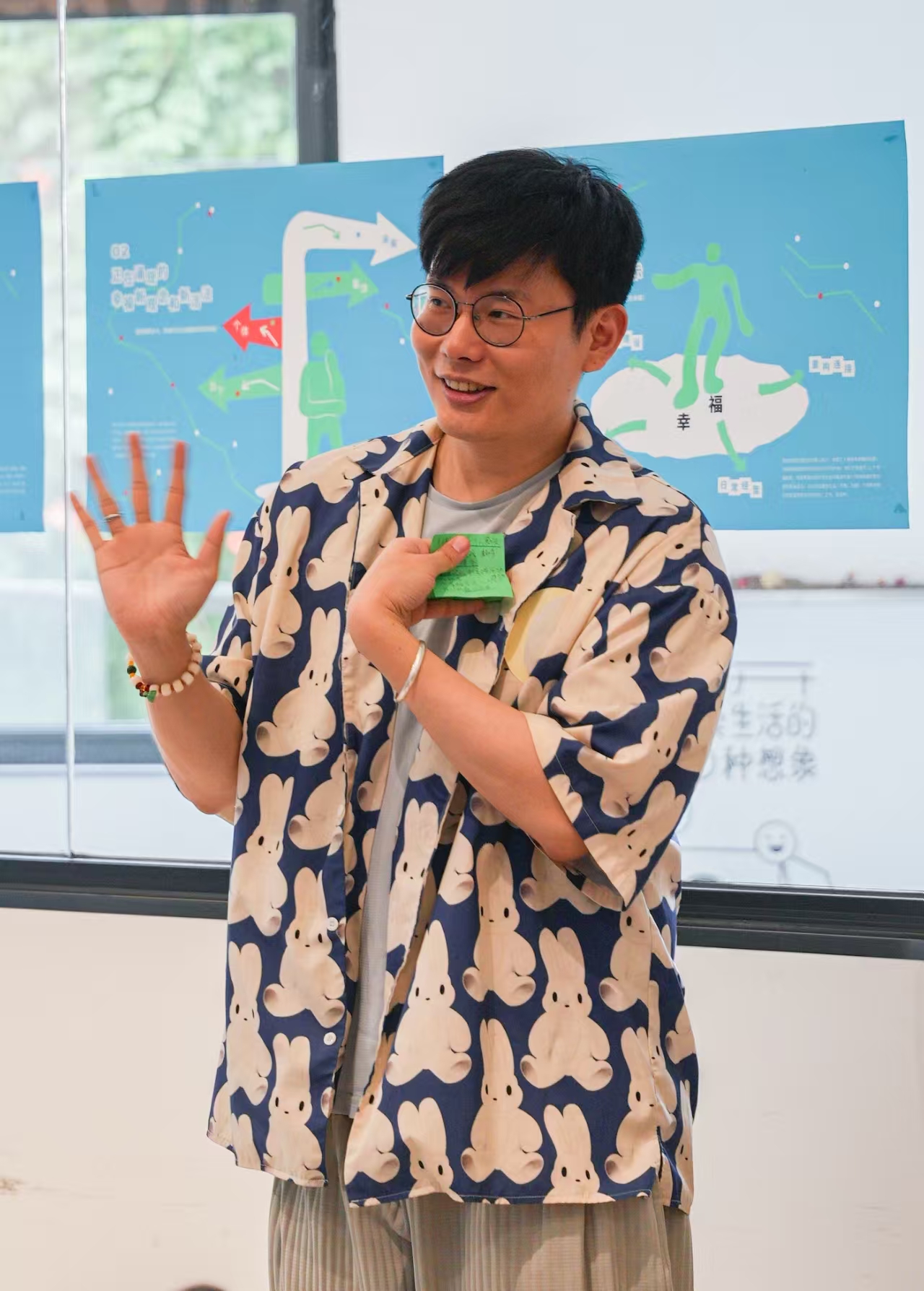
Jiakun Wang
Based in Shanghai, Jiakun Wang works where semiotics, foresight, and social innovation meet. He is interested in cultural weather: the ways moods, symbols, and social desires gather into new forms of life. His current inquiry asks whether China is moving from the metamodern toward a “perimodern” condition, and how happiness changes as that transition enters everyday rituals, services, and imaginaries. He also describes himself as a happiness coach, treating happiness less as self-help than as a social and cultural question.